

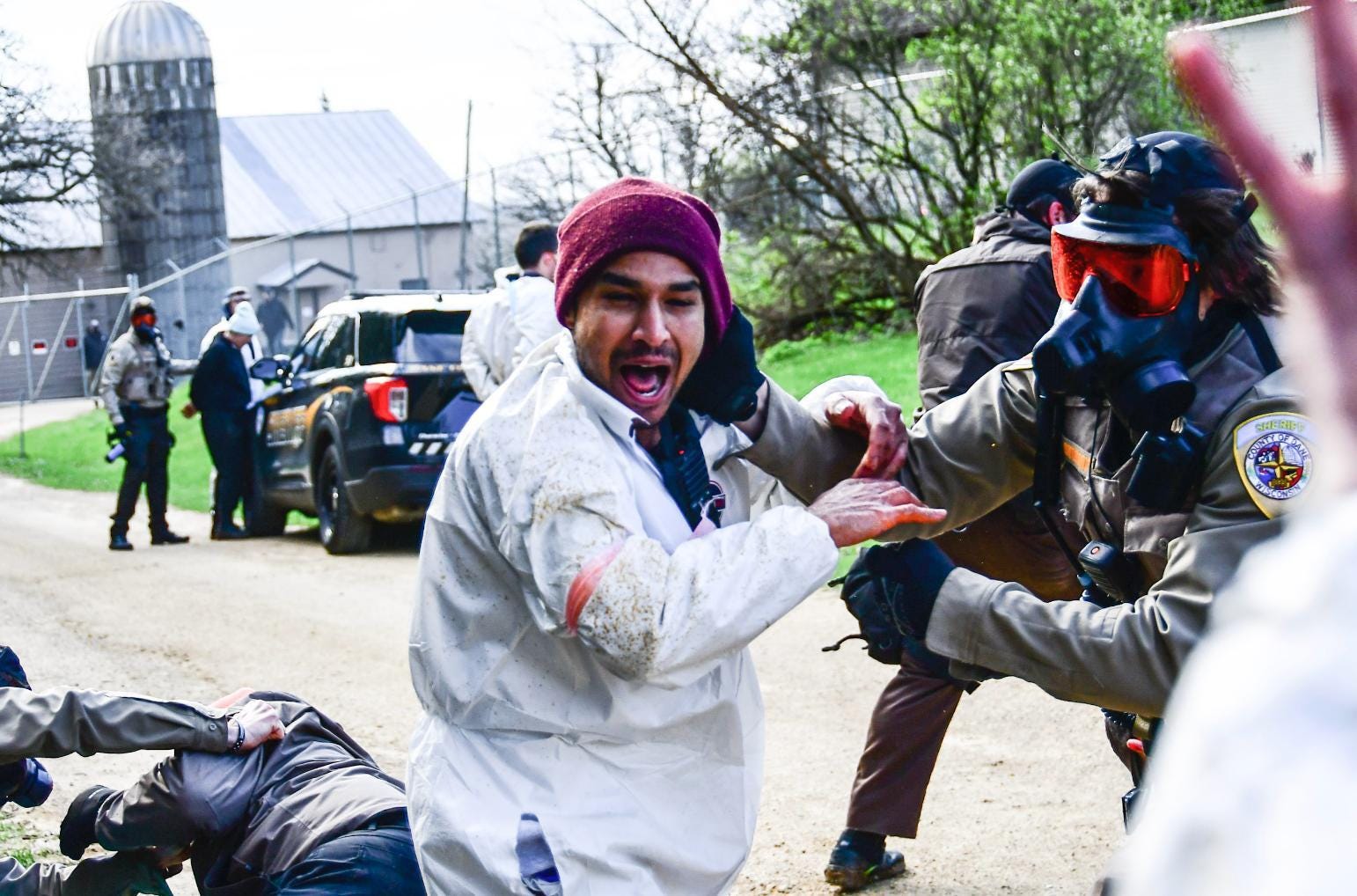
I wrote this post during the three nights I spent in jail after the April 18 rescue attempt. It is now being published with minor edits about 6 weeks after being released from jail.
“What do I do?! What do I do?!” Our driver asked, frantically. We had just arrived at Ridglan Farms and we were blocked from our planned dropoff point by a police blockade. “We’ll get off now and run,” a team member said. And so we got off the SUV a few hundred feet from the planned dropoff and ran to our destination: the front gate. However, as we crossed over the slight hill in front of Ridglan, we saw a group of our fellow activists there already under arrest. So we pivoted again.
My team was tasked with creating openings in the wall of hay bales surrounding the facility. Unfortunately, our planned point of focus near the front gate had a police presence. We instead decided to focus on a section of the hay bale barrier with fewer cops. In front of the hay bales was also a 2 foot moat filled with dog poop.
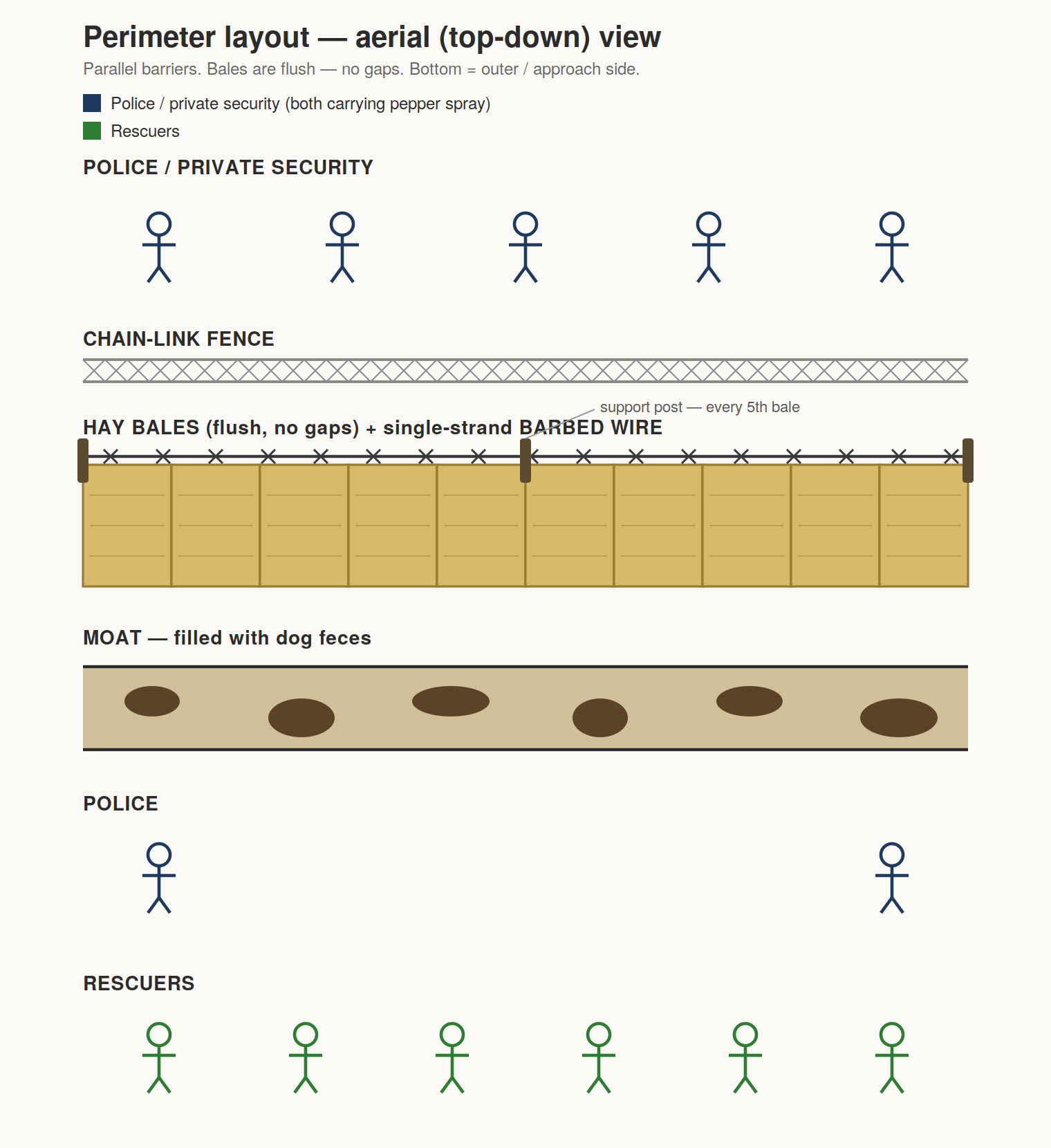
So I jumped into the moat (luckily there wasn’t much poop at this part), climbed up a bale, slid under a barbed wire fence that was placed atop the bales, and got to the other side. I then tried to push a bale into the moat. Even with the support of two other team members though, the bale wouldn’t budge. These 4 foot tall bales were heavy enough as is and it didn’t help that it had rained the night before so they were quite wet and so heavier. Unfortunately, even when more of my fellow activists arrived, more police showed up too and they were armed with pepper spray. This was unexpected. Never before in the history of nonviolent open rescues have police used crowd control tools like this. Little did we know at that moment that this was just the beginning.
As we approached the bales to create openings, the police approached us. We backed up and started moving to other bales, but police were there too. I yelled at one of the cops with pepper spray: “We have a legal right to be here! They’re performing surgeries on dogs without anesthesia! We have a right to rescue them!” The officer was silent. Indeed, how can someone justify defending a multi-million dollar, dog-abusing corporation? Especially if one has dogs at home.
As we weren’t making much progress on bales, we moved back to the front gate where more activists were gathered. I thought to myself, “Maybe if we kept the police’s attention at the front gate, other activists could breach the facility from other sides.” I joined other activists near the front gate and chanted, “Save the dogs! Save the dogs! Save the dogs!” Then I heard someone on a megaphone say, “All right everyone, all together we’re going to walk past the police!” And so we started walking closer to the police. I watched as police violently threw people to the ground and pepper sprayed everyone. I kept walking and almost made it past a cop. That’s when I got hit with pepper spray in both eyes. The burning was intense and my eyes refused to open. I was functionally blind. I started walking back a bit, away from the gate, but I tried to keep chanting, “Save the dogs!” That’s when I ran into someone who recognized me. They realized I was blind. So they helped me walk towards the gate again. However, in the chaos I somehow lost them. As I kept walking, I realized I should just stop and sit down. I’d likely just be a burden to my fellow activists if I blindly just dithered around. So I just sat down and was fully with the pain of the pepper spray.
It is in moments like these that I’m so grateful for my mindfulness practice. As intense as the pain from the pepper spray was, it never overwhelmed my mind. With mindfulness, even this pain was manageable, even as tears streamed from my eyes and snot streamed from my nose. I then felt my hands pulled behind me and felt zip tie handcuffs tighten around my wrists. Sometime after, I found myself near other activists. “Officer, can someone get him some water to wash the pepper spray out of his eyes?” someone had asked. Someone else then came by me and then guided me to lean my head forward so they could pour water over my face. This eased the pain for a moment, but did not help so much. I still couldn’t open my eyes.
I asked if someone nearby could tell me what was happening. They told me that several more activists had gotten arrested and were sitting right next to me. They also said there were police nearby. “Officer, can you hear me? Would you be open to some dialogue? I genuinely want to know what you think of all this,” I asked. The officer politely declined. I then addressed a nearby activist, “How many activists are here and how many police are here?” “12 activists and 2 police,” they replied. I then realized that with these ratios, even a few police could restrain quite a number of us. “I have an idea, even if we can’t rescue dogs ourselves, we could tie up more police resources by standing up and walking away nonviolently,” I suggested. This activist agreed with the plan and, on the count of three we yelled, “Everyone! Let’s get up and start walking away nonviolently!” So I got up and started walking. The police quickly threw me to the ground. “Escaping will lead to another felony charge. If you don’t sit down, you will be pepper sprayed!” The pepper spray threat unfortunately convinced me to stay still. I could still feel pepper spray burning my eyes and face at that moment, I was worried about creating the conditions where my fellow activists get pepper sprayed, especially as I didn’t see a clear pathway to rescuing dogs even if we did accept that risk.
And so I just waited. I kept thinking what, if anything, I could do in that moment to be of help. I even fantasized about different superpowers I could suddenly attain that could allow me to save the day. Unfortunately, I couldn’t think of anything and so I just kept waiting. We were then moved to a different location. I continued to just wait and chat with my fellow activists. In the background, we could hear cheers which were encouraging and gunshots, which were frightening. At this point, the pepper spray had worn off enough that I could see out of my right eye but not the other. Then we started to smell something that I was told was tear gas. Thankfully, we were far enough away that we only coughed some and had to shut our eyes. I imagined those closer to the tear gas were not so lucky.
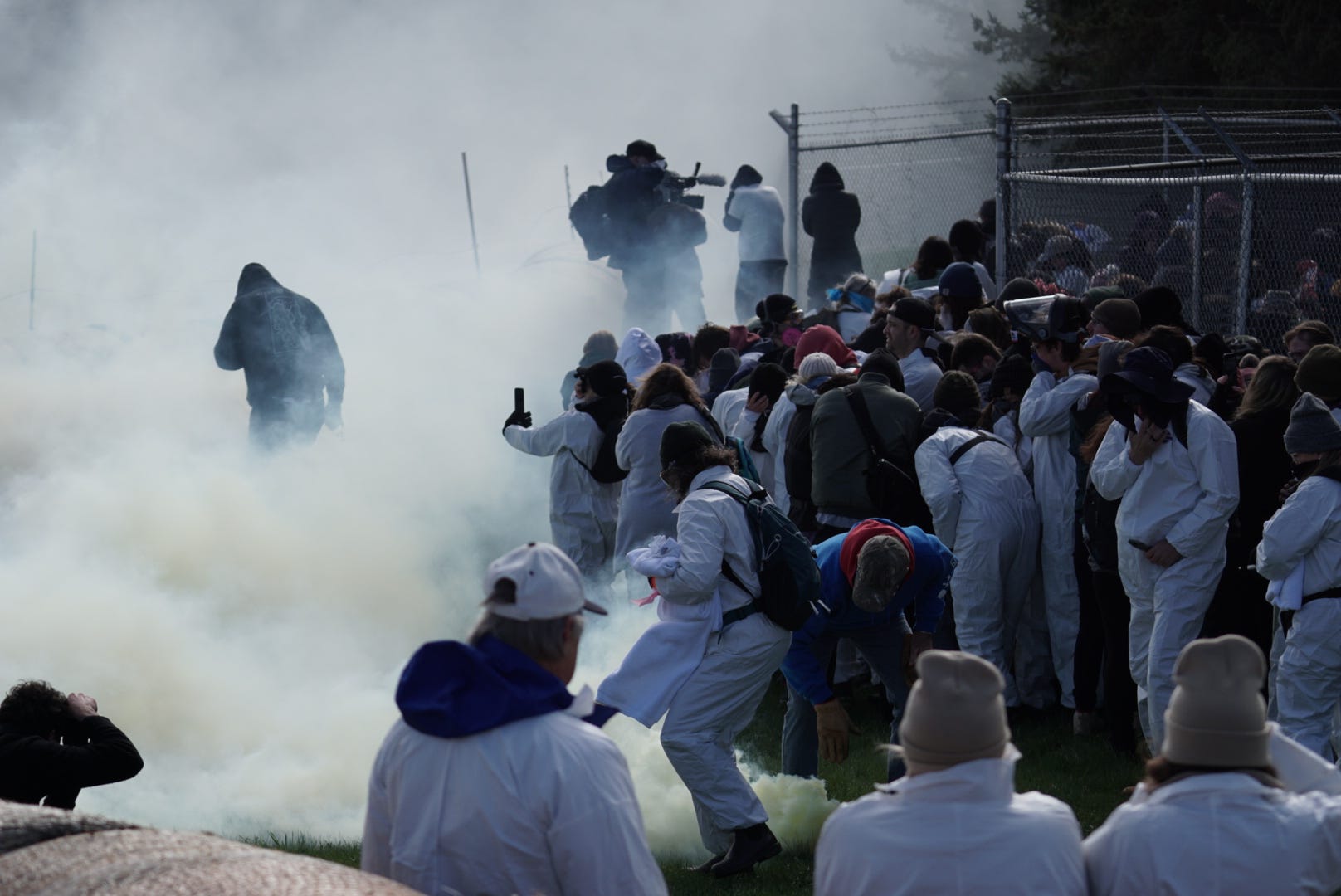
We were all now sitting near building three, the same building we rescued dogs from during our March 15 open rescue. The vent fan that was our prior breach point was firmly sealed. Building two’s north side was also in our sights and I saw no activists. It then began to dawn on me that we were likely not saving any dogs that day. The pepper spray had worn off more and I could finally see from both eyes again. I’d realized in that moment how much I had taken my vision for granted. Then we saw a massive armored vehicle drive by with what seemed like a turret gunner on top. I had underestimated how militarized these police had become.
As I was simply sitting and waiting, I asked another cop if they were open to dialogue, and they also politely declined. I’m happy that, eventually, we did get the chance to connect with one cop. However, even this cop failed to take a definitive stance for or against the animal cruelty taking place at Ridglan. One would hope that someone with as much authority and power like a cop would convey some moral clarity. But unfortunately this seems to be too much to ask.
Afterwards, my fellow activist, Dean and I were taken to a paddy wagon with some other arrestees. I was shocked to see they had even arrested an elderly woman who appeared to have been pepper sprayed (or had at least been hit with some tear gas). She told us she was a grandma with 5 grand kids. She was sad she couldn’t rescue even one dog. Had our government really stooped so low that taxpayer money was spent to tear gas a grandma to prevent her from rescuing a puppy out of an animal-abusing, multi-million dollar corporation? Is this really the kind of country we want to live in?
We were then transported to the Verona police department where the cops filled out paperwork for us and searched us. Out of the 8 of us in that paddy wagon, I saw 4 being immediately released. Three of us, Dean, Misha, and myself were taken to the Dane County Jail in Madison to be booked. The eighth was also later released.
Getting booked proceeded just like last time, with one small change: I was called into an interview room by agents from the Wisconsin Department of Justice. “I’m going to read you your Miranda rights,” said one agent. Prior to that interview, I was feeling openness to talking with the government without a lawyer. But once I sat down with them, I felt this deep gut feeling that it would be wise to speak with a lawyer first. I decided to not sign the papers waiving my Miranda rights. And so, the interview ended as soon as it started.
Soon after this, after having spent some time in a holding cell, I was moved to a cell with beds. I happened to be put in the same one as Wayne who I was happy to see. We caught up and shared stories. Or I mostly shared my story as he was arrested immediately after arriving at Ridglan and had spent the whole day in jail.
Then I sneezed and my eyes watered slightly. This reactivated the pepper spray/tear gas that had dried on my eyes/face. My eyes started burning again. I then foolishly poured water over my eyes and this made it worse. I was once again temporarily blind. Wayne kindly guided me around the room and gave me tissues to wipe my eyes and nose which were streaming again. Thankfully, this time, the pain passed in about 30 minutes or so.
I got a good night’s sleep and the next day I was moved to a new cell because Wayne and I were involved with the same “crime.” I hugged Wayne goodbye.
While I was sad to say bye to Wayne, I ended up making new friends in the other cell! I spoke with Mark*1, Kelvin*, and Lish about our rescue effort and they were quite supportive. “Humans are horrible,” Lish said. Everyone was shocked to hear that Ridglan did surgeries on beagles without anesthesia. “Dogs are the most loyal animal,” Kelvin said. “And they’re taking advantage of that,” I responded. I really appreciated hearing their support for our efforts. It meant a lot to me.
Since being arrested on the morning of Saturday, April 18th, I’ve been in an information vacuum. Through phone calls with my lawyers, I learned that the police used rubber bullets in addition to tear gas and pepper spray. One person was almost hit in the eye. Several others were hospitalized, including an elderly man who was restrained by the police and then pepper sprayed. Another person was kneed in the face so hard that he lost teeth. But despite all this brutality, I’m proud to say our activists remained nonviolent. We bore suffering without retaliation.
I also feel grateful to say the country is paying attention. We just got coverage in the New York Times. And while we failed to save any dogs yesterday, I feel optimistic about the movement we are building. Over 1,000 people showed up to rescue these dogs, even if it meant risking arrest and violence. One day, all these dogs will be free. We’ll do our best to make this dream a reality.
“We don’t write the laws,” is what one officer told me when I asked her if she’s allowed to refuse following orders she deems unjust. I have been pondering why the police continue to support Ridglan when the public at large (and even members of the police), condemn Ridglan’s actions. Why do so many police choose to follow the orders they may disagree with? Why do they avoid talking to me? And when they do talk with me, why do they try to deflect instead of giving me clear and direct answers?
I tend to see things from a Buddhist perspective. While I don’t know the precise reason why the police support Ridglan, what I feel confident about is that “Avijjā” has something to do with it. In the language of Pali, a language spoken during the Buddha’s time 2,500 years ago in Northern India, Avijjā can roughly be translated as ignorance. All of us have varying degrees of ignorance. For example, this is why we do things that cause us suffering while believing they will make us happy (for example, think of any addiction). Avijjā also can be translated as “not seeing reality clearly.” Indeed, someone must be far from seeing reality clearly if they believe that kneeing someone in the mouth and causing them to lose teeth is an appropriate response to them trying to liberate puppies from cruel experiments. In my experience, the only thing that has helped me reduce my ignorance (and I still have a lot, by the way), is mindfulness practice. Only by sitting with myself in silence have I learned what are the underlying beliefs and patterns beneath my behavior. And only by seeing them and understanding them can we be free of them. I hope that someday these police and government officials come to realize that, “I was just following orders,” is not a good excuse for engaging in unethical behavior.
What comes next is written at the time of publication as a brief update of what has happened in the last 6 weeks.
As you likely already know, I’m happy to say that thanks to the efforts and generosity of the folks at Big Dog Ranch Rescue and the Center for a Humane Economy, 1,500 of the dogs have been freed. However, it seems as of the time of writing this post, about 500 dogs still remain trapped at Ridglan. Efforts are still under way to negotiate their release.
I and three of my fellow activists: Wayne Hsiung, Dean Wyrzykowski, and Misha Lunsky, have each been charged with four felonies. We are now each facing up to 31 years in prison and $72,500 in fines. These fines do not include restitution, in other words, damages that would be paid directly to Ridglan. This restitution could potentially be in the six figures.
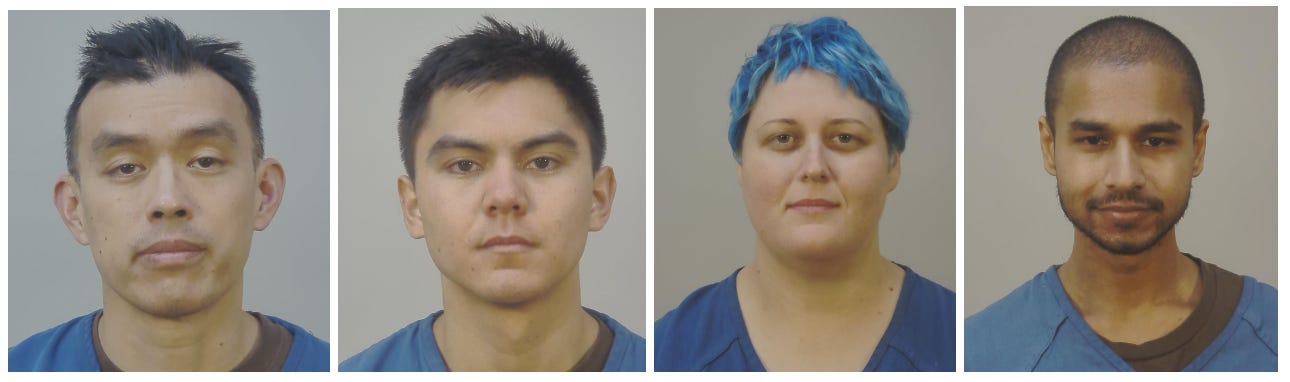
As scary as these charges seem, we’re not giving up. We look forward to our day in court where we’ll argue to the jury that we had a legal right to rescue these dogs from criminal abuse. We are confident that a jury of our peers will acquit us. And in the worst case scenario that we are convicted and need to spend years in prison, then so be it. While I would prefer not to do that, if that ends up being the price we needed to pay to help these dogs find freedom, then so be it. We will pay it.
As Martin Luther King Jr. said, "We know through painful experience that freedom is never voluntarily given by the oppressor; it must be demanded by the oppressed." And as these animals are incapable of demanding this freedom themselves, we will continue demanding it in their place.
An asterisk* means that their name was changed to protect their privacy. I got Lish’s permission to use his name.
✨️💖✨️✌🏼🫶🏽
Looking forward to seeing you at the DeathStar. . .
Super hero activities :) Love the diagram representation hahaha. Looks like an explanation of a medieval siege from a history book