

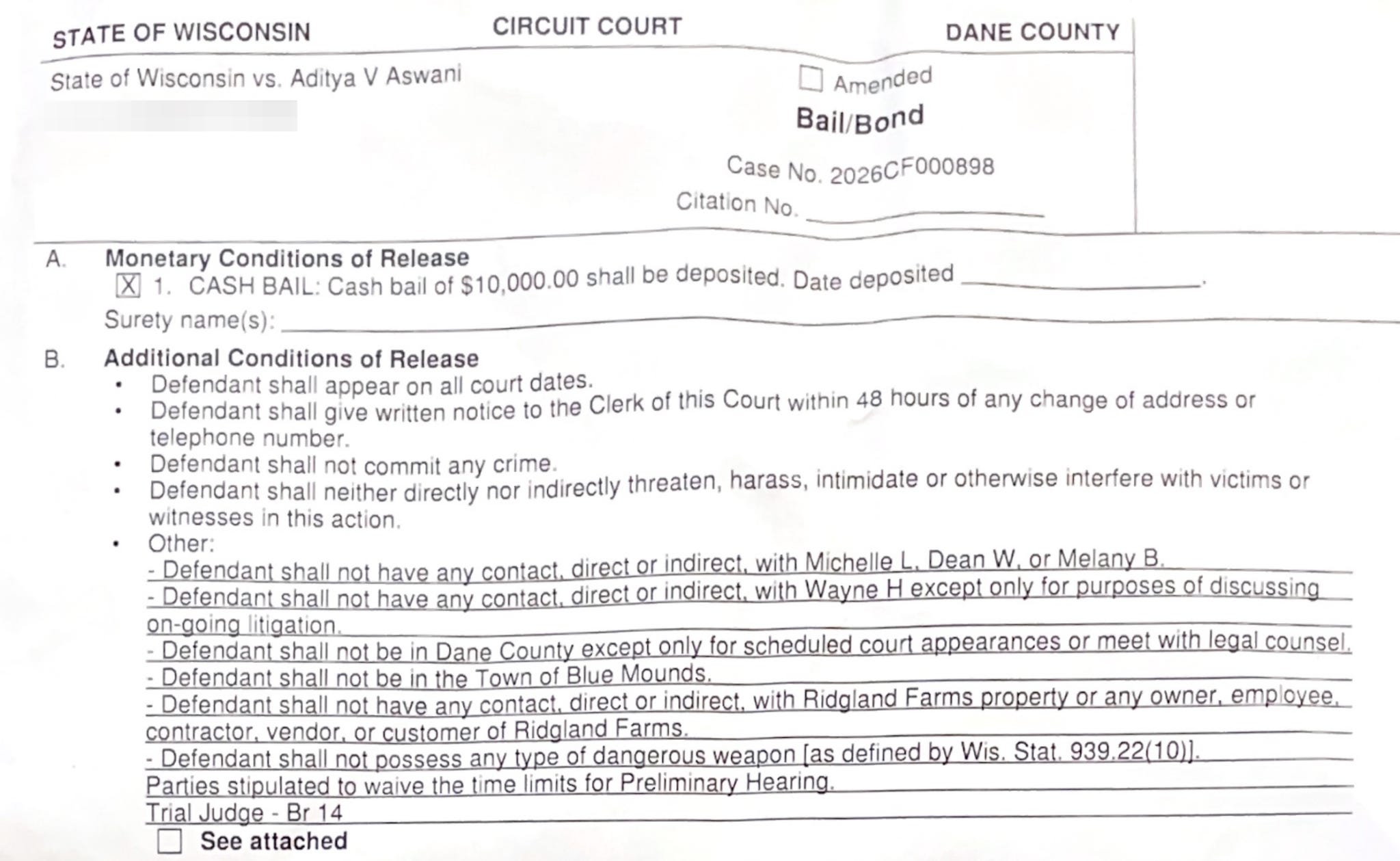
As a condition of my release from jail, a Wisconsin court has barred me from speaking to a wide network of American institutions — including a public research university — about the very issue I’m being prosecuted over.
Hold onto that sentence, because everything in this piece flows from it. Here’s how it happened. After the second Ridglan rescue attempt on April 18, I spent three nights in the Dane County Jail. On the fourth day, I had my bail hearing. Bail is a financial guarantee that a defendant will return for their court date: I’m innocent until proven guilty, so the state can’t simply hold me, but by making me put money down it gives me something concrete to lose if I don’t come back.
So why do I have nine other conditions attached to my release? Because bail today does more than guarantee appearance. In Wisconsin, conditions of release are governed by Chapter 969 of the state statutes, and under § 969.01 a court may impose them for three purposes, and only three: to assure you appear in court, to protect the community from “serious harm,” and to prevent the intimidation of witnesses.1 Hold onto those three purposes too. Every condition is supposed to serve at least one of them — and the condition I opened with serves none.
The Speech Ban
I’m barred from any contact, direct or indirect, with Ridglan Farms. Not just the property. Not just the owners. Not just the employees. Also the contractors. The vendors. And the customers.
Read that last part again. Ridglan’s customers and vendors include universities, laboratories, and suppliers across the country.2 By forbidding me from contacting any of them, the court hasn’t just told me to stay away from a farm. It has told me I may not speak to a large set of institutions about anything — including the very thing I’m being prosecuted for caring about.
Here’s what that means in practice. The University of Wisconsin–Madison (UW-Madison) — whose research labs have bought beagles from Ridglan — is formally investigating a student group, Animal Advocacy, over a flyer promoting the rescue effort:
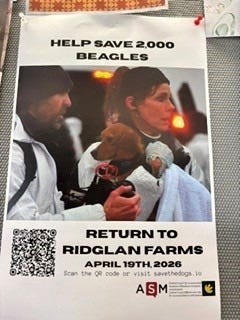
I think the university is mistaken for carrying out this investigation, and there’s a deeper problem: UW–Madison is a public university, bound by the First Amendment. When a government institution opens a misconduct case against students for advocacy directed at its own supplier, that is the government penalizing speech — and not from a neutral position.
I would like to make that case to UW–Madison directly. I can’t. UW–Madison is a Ridglan customer, so contacting the university — about the investigation, about its purchases, about anything — would violate my bail. If I wanted to protest the fact that a public university has bought dogs from Ridglan at all, I couldn’t do that either.
Courts have long recognized that conditions of release can’t trample constitutional rights. When a condition restricts protected speech or association, it has to be drawn narrowly — tied to a genuine risk, not a blanket prohibition that sweeps in lawful advocacy. A condition that bars me from speaking to an entire network of institutions, about a matter of public concern, is the opposite of narrow. It reaches my activism, my writing, and my ability to organize — none of which threatens anyone’s safety. Call this what it is: not a bail condition, but a speech ban.
What the Condition Actually Protects
To be fair to the court: it doesn’t need to find me dangerous to order me to stay away from Ridglan itself. Keeping a defendant from repeating the alleged offense against the same target is the ordinary purpose of a no-contact condition, and Wisconsin law plainly authorizes one covering the property and the people who work there.
But a keep-away order is one thing. A ban on contacting Ridglan’s customers and vendors is another. It doesn’t protect anyone’s safety. It protects one thing: Ridglan’s revenue.
And here the relevant Wisconsin law should trouble you more than it comforts the court. In April 2023, voters amended the state constitution to let courts impose release conditions protecting the community from “serious harm” — dropping the word “bodily” — and the legislature promptly defined “serious harm” in § 969.001 to include “economic loss over $2,500 in value.”3 Read literally, a company’s lost sales now count as exactly the kind of harm bail conditions exist to prevent. Targeting a company’s business relationships is a familiar tactic in corporate pressure campaigns, and a condition like this one is built to shut that down — with the statute’s blessing.
But while a statute can define harm however it likes, it cannot define away the First Amendment. A release condition that restricts protected speech must be narrowly tailored to a genuine risk, and a blanket ban on speaking to an entire network of institutions about a matter of public concern is not narrow tailoring. The legislature is free to call lost revenue “serious harm.” It is not free to make criticizing a company’s customers a jailable offense for someone who hasn’t been convicted of anything.
My story is sadly one chapter in a larger saga. For decades, state legislatures have tried to criminalize speech that threatens animal industries’ revenue. “Ag-gag” laws make it a crime to film undercover inside factory farms. Courts have repeatedly struck down these laws, but legislatures keep passing new versions anyway.4 Our lawmakers answer to the industry, and not to us.
A Change of Heart
There’s a better part to this story. The court commissioner who imposed my conditions at the bail hearing and my trial judge are different people, and after my lawyers raised concerns, the trial judge modified my conditions.
The original order had barred me from communicating, directly or indirectly, with my co-defendants — Wayne, Dean, Michelle (Misha), and Melany — and from entering Dane County at all. This order disconnected me from my community. I had to remove myself from several group chats and skip our mass Zoom calls. Most importantly, I couldn’t simply check in on how my friends were doing as we grappled with the possibility of decades in prison. The no-contact order also added needless friction to coordinating a defense, which had to run entirely through our lawyers. And the Dane County ban meant that after my release from jail, I couldn’t even stay in Madison to be with friends — I had to leave the county immediately.
To his credit, the trial judge lifted both. That’s the system working the way it’s supposed to: a bad condition challenged and corrected. I’m grateful for it. What remains is the Ridglan condition — and that’s the one still doing damage.
No Conditions for Ridglan
Here is the asymmetry that stays with me. The court set ten conditions on me — monetary bail and nine more. It set none on Ridglan, because in my bail papers Ridglan is the “victim” in need of protection.
It doesn’t matter that this “victim” hired a private security force that threateningly waved a gun at peaceful protestors.5 It doesn’t matter that this “victim” had a representative who almost ran over me and other rescuers with his pickup truck. It doesn’t matter that this “victim” is a multimillion-dollar corporation that has performed surgeries on dogs without anesthesia.6 When an industry breaks the law, the government does nothing. When we openly rescue animals from abuse, the government gives us four felonies apiece.
Sunlight
So what do we do? We keep speaking up when we see injustice, and we keep directing public attention toward what companies like Ridglan and Marshall BioResources — one of the world’s largest breeders of dogs for laboratories — would rather no one see. We do it even when it carries risk, because attention is the one thing these industries can’t stand. They depend on the fact that most people don’t know they exist — let alone what they do. When I tell people what they do to dogs, they are appalled.
Marshall would prefer to stay invisible too. You won’t find it on Google Maps; to locate it, you have to enter the address directly: 5800 Lake Bluff Rd, North Rose, NY 14516. For an industry that thrives in the dark, sunlight is the best disinfectant. But awareness is not enough. We must act on it. And in some cases, that means nonviolent direct action.
§ 969.01(4) - Wisconsin Legislature: 969.01
Rise for Animals / The Marty Project - Ridglan Farms buyers list, March 2022–July 2025: Still Buying Dogs from Ridglan? Now We See You...
§ 969.001(2m) - Wisconsin Legislature: 969.001

Thank you for your courage in the face of such uncertainty and for inspiring others to keep fighting - together, we will prevail.
So the trial judge did not lift the restriction to speaking to the customers and vendors?
Sadhu! ❤️